This is not your best night. You're on your own, hungry, stuck somewhere in the middle of an unending project you never wanted to do. After 9 o'clock, you leave your apartment to wander the streets in search of something to eat. Did you even eat lunch? You can no longer remember. All around you, the streets are crowded with people determined to have a good time. You, on the other hand, end up in Burrito-town, population 13. The menu board shows off the Burrito-town chain's sense of humor. Pains have been taken to give each Burrito-town burrito a funny name. There are burrito's called, "Mr. Bean," "No, Woman, No Cry," "Pulpo Fiction," "CBGB (Corn, Beans, Garbanzo Beans)," "Old Yeller," "Holy Mole!," and "Dude, where's my chorizo?" Each of these burrito's come in multiple sizes, ranging from "Gi-normous" to "Webster."
You have a profound need for sustenance.
While you eat you watch the tv screwed into the wall above the cashier. There are a few scenes of people keep getting in and out of cars, followed by a lunch at a country club cut short by an angry outburst. Because of the bad reception and inaudible volume, whatever story the images are trying to tell is impossible to follow. Instead, you enjoy one of the many mixed pleasures of living in this city. You listen to a stranger describe his novel. There are two guys in the booth beside you. One of them is eating a "Holy Mole!," the other is just eating chips. The guy with the chips is almost finished his first draft.
"It's about this guy," he says. "He's a regular guy, he's got a job, an apt, whatever, but one day - and I'm really sure yet exactly how this happens, but I think it involves getting into a car accident with the Devil - the guy ends up with this amazing power. Everything he wants to happen, happens. He can, like, control everybody with his mind. He goes to the office and he gets a raise. Just because he wants it."
The other guy with the burrito interrupts him, "What does he do with this power? Does he become President? Does he figure things out in the Middle East?"
"Whooah, that's way out my league. This is my first novel." He dribbles some green salsa on his chips. "What the guy really wants is to get a girlfriend."
"Shouldn't be too hard."
"It isn't. But that's the problem. I mean he can get any girl he wants. There's no challenge anymore. The moral of the book is, kind of, be careful what you wish for - and there is such a thing as too much of a good thing. After a while the guy gets fed up with the mind control. I mean, he realizes that the girls don't really want him. It's not real. He ends up getting really depressed. He just sits in his apartment and watches tv all day. Pretty much what he was doing before he got the special power, only now his apartment is a lot nicer, because he makes, like, mad bank."
The "Holy Mole!" guy nods. "If I had more money, I'd buy one of those hd plasma flat screens."
"Yeah, totally. And get digital cable."
You've eaten half of the burrito and you're full, but you stay to hear the guy with the chips explain how the book ends.
"Well, one day the dude meets a girl he can't control, and the whole question is like, 'is she the devil or is she the love of his life?"
"That's some profound shit. Which one is she?"
"Both."
"Wow."
"Yeah, originally it was a screenplay. But I got a lot of feedback on my blog about how the plot was hard to follow. So I figured I would make it into a novel."
"Cool."
It's time to go home and write.
Monday, July 31, 2006


Thursday, July 27, 2006
Instructions for Reading Your Work in Public
First, schedule your reading somewhere, anywhere, that is extremely not easy to find. An alley behind a derelict girdle factory. A fallow field along a disused state highway. A hidden alcove on one of the upper floors of the condemned records building of an abandoned steel town. This is the critical first step to making sure you will have an unsuccessful reading. Next, remember to never tell anyone about the event, especially not your relatives or closest friends. If a mention of your upcoming reading accidentally slips out, deny what you have just said. If denial fails, plead drunken confusion. If you are clearly sober, sabotage the friendship. If your friends turn out to be social masochists and your bridge-burning attempts only increase their desire to hear you read, change the venue, making sure to move it by a distance of at least ten miles; also change the time of day by at least six hours, the date by at least three months. If you become worried that you might slip again, consider keeping the details of your reading a secret even from yourself.
No matter where you end up having your reading, make sure it is nowhere near a bookstore. Ideally, your reading should likewise be in a dry county, in a state that has no truck with literary culture. Sobriety and willful ignorance will be vital to the failure of your event. Next, get a job you hate, one where you are worked to the bone, drained dry at the end of every shift, with no energy remaining for creative endeavors. Make sure that the job has glimmerings of practicality, but only faintly so; your parents should be somewhat relieved, but still concerned. "The beef rendering industry isn't going away anytime soon, that's for sure," they should say, smiling nervously, "but do assistant sluice managers have any room for advancement?" Whatever your vocation, make sure you have no time left over for writing: take extra shifts; bring work home with you; sign up for a correspondence course. If you have not done so already, develop a taste for alcohol. Let your love grow, but not like a well-tended flower, more like an ignored and sturdy vine, weedy and ferocious in its impulses, the tendrils of your habit entwining with the ramshackle chicken wire of your self-loathing. Lose money. Forget your passions. Forget, if you can, that you ever even wrote a word. Go to seed. Become pasty, disheveled, untucked. Be prone to haphazard spasms of knowing, disgusted laughter. Eat the leftovers of others from the break room refrigerator. Steal medicines you have no use for from the pharmacy. Begin a collection of old newspapers; keep them fastidiously folded in paper bags, hidden inside the Murphy bed in the basement apartment you call home.
When it comes time for your reading, let it take you completely by surprise. Frantically dig the manuscript of the first chapter of the novel you began as a sophomore out of storage. As you bang up the stairs and out through the screen door and across the crumbling pavement and eager dandelions, skim your pages, your eyes crusting over with nostalgia. Such early promise! Head out to your reading—in the far corner of the empty mimeograph repair shop, at the bottom of the dry quarry, under the neglected wharf—both horribly late and deeply satisfied at your own fragmentary genius. Drive into the early evening sun remembering that time you got into an argument with your ex—back in college, when you were still going out—about all the unpublished work Hemingway's first wife lost in that Paris train station. Wasn't it a damn shame? Wasn't it a great loss to literature? "Oh, no," you replied, smiling wistfully, "Don't you see the beauty of it? That no words can ever be as good as those which can't ever be read?"
No matter where you end up having your reading, make sure it is nowhere near a bookstore. Ideally, your reading should likewise be in a dry county, in a state that has no truck with literary culture. Sobriety and willful ignorance will be vital to the failure of your event. Next, get a job you hate, one where you are worked to the bone, drained dry at the end of every shift, with no energy remaining for creative endeavors. Make sure that the job has glimmerings of practicality, but only faintly so; your parents should be somewhat relieved, but still concerned. "The beef rendering industry isn't going away anytime soon, that's for sure," they should say, smiling nervously, "but do assistant sluice managers have any room for advancement?" Whatever your vocation, make sure you have no time left over for writing: take extra shifts; bring work home with you; sign up for a correspondence course. If you have not done so already, develop a taste for alcohol. Let your love grow, but not like a well-tended flower, more like an ignored and sturdy vine, weedy and ferocious in its impulses, the tendrils of your habit entwining with the ramshackle chicken wire of your self-loathing. Lose money. Forget your passions. Forget, if you can, that you ever even wrote a word. Go to seed. Become pasty, disheveled, untucked. Be prone to haphazard spasms of knowing, disgusted laughter. Eat the leftovers of others from the break room refrigerator. Steal medicines you have no use for from the pharmacy. Begin a collection of old newspapers; keep them fastidiously folded in paper bags, hidden inside the Murphy bed in the basement apartment you call home.
When it comes time for your reading, let it take you completely by surprise. Frantically dig the manuscript of the first chapter of the novel you began as a sophomore out of storage. As you bang up the stairs and out through the screen door and across the crumbling pavement and eager dandelions, skim your pages, your eyes crusting over with nostalgia. Such early promise! Head out to your reading—in the far corner of the empty mimeograph repair shop, at the bottom of the dry quarry, under the neglected wharf—both horribly late and deeply satisfied at your own fragmentary genius. Drive into the early evening sun remembering that time you got into an argument with your ex—back in college, when you were still going out—about all the unpublished work Hemingway's first wife lost in that Paris train station. Wasn't it a damn shame? Wasn't it a great loss to literature? "Oh, no," you replied, smiling wistfully, "Don't you see the beauty of it? That no words can ever be as good as those which can't ever be read?"
Sunday, July 16, 2006
The Future of the Book of the Future
The first to go will be the editors, although this won't happen immediately; the end will be a slow decay, not unlike the legend of the frog ignorant of its own boiling. Editors will, with all the best intentions, stop making it to the ends of manuscripts; then they'll drop the skimming of sample first chapters; and then, finally, realizing that it is not only possible, but preferable, to conduct their business without the distraction of print at all, the editors will no longer even bother with pitch letters. The only employees remaining at the publishing houses who actually consider the words contained inside the objects those houses produce will be the typesetters, who will no longer be native speakers, necessarily, but rather the cheapest purveyors of this service, depending on the strength of the dollar and other sundry global market forces: one day the typesetters of diet books in English may be Bangladeshi, vice versa the next; Argentinians will typeset Danish poetry; Ethiopians, Mexican political tracts; and so on. Once the agents realize that the editors are no longer reading, they shall follow suit, and instead will only pitch the works of their most attractive clients with the sexiest-sounding ideas. Hard on the heels of the agents will be the writers, who never much liked the grunt work of stringing sentences together anyway, greatly preferring to lounge around fashionable saloons, or their own living rooms, complaining to friends and strangers and colleagues and pets alike about the monumental and laborious difficulties of their chosen trade. Writers shall, instead, simply cobble together documents as random collages of appropriated texts, cribbed willy-nilly from their own correspondence, the stories they wrote in graduate school, the essays they wrote in college, various novels of yesteryear that may or may not have entered the public domain, maps, weather reports, stock tickers, and the Bible. Soon the only professionals remaining in the publishing world who still read books—actual, physical books; books from beginning to middle to end—will be the critics. They will rant and rail, vent and brickbat, sputter and spleen at these paper gallimaufries, but the newspaper and magazine owners of the world will discover, through scientific polls, that not a soul cares for the book reviews anymore, preferring, instead, to spend their valuable time ingesting interesting new facts, such as how fighting crime can aid the shedding of pounds, how renouncing freedom can lead to a pointier chin, a more savage nose. The critics will throw up their hands in submission and willingly dance on the grave of literature, but no one will notice, because their employers will have long since moved on to more promising schemes, like investment real estate and amateur pornography. The interesting facts still printed in the newspapers and magazines will blur around the edges, fray at the seams, then finally explode in a colorful, lusty, mouthwatering display of mixed metaphors. Without fiction still extant as its natural counterpoint, the word "fact" will come to mean "something extremely delicious that maybe you can buy right now with money." The word "truth," lacking novels to tell deeper versions of it, will evolve until it means "attentive ladies offering extraordinary special massages for discerning gentlemen." Dictionaries—the books still referred to as "dictionaries"—will entirely consist of advertisements for call girls; grammar will slink off to the dusty cemetery where propriety, etiquette, socially progressive taxation, high-fiber diets, spelling, and whalebone foundation garments lie waiting for its arrival; and the streets and alleys of the cities of the world will be full of joyous humanity and all the naked alphabets and ideographic systems of all the human languages, rutting continuously and without shame, letters and fluids and ink strokes and dead skin shedding into the gutter like so much unnecessary baggage, like the struggle to find the right word, leaving only, in its place, a magnificent collage.
(See also: "End of the World of the End," Cronopios and Famas, Julio Cortázar.)
(See also: "End of the World of the End," Cronopios and Famas, Julio Cortázar.)
Saturday, July 08, 2006
Reading Older Stories
"It's like," he said, tapping the end of his cigarette on the edge of the ashtray, "it feels like there was this whole world, see? I mean, what I mean is, a whole world of stories. Geez, I don't know if I'm making any sense." He stubbed out his cigarette, got up from the couch, and walked to the kitchen. "You want another beer, honey?" he asked. She nodded at him from the couch. "Okay. Okay, I'll get us both a couple beers," he said. "I'd like a beer," she said. He got the beers from the refrigerator and walked back to the couch. "What do you mean when you say it's like it was a whole world?" she asked, grinning at him. "You're not going cuckoo on me, are you?" He pulled the tabs off both beers and dropped them in the ashtray with the dead cigarettes. "Hey, I'm no loon," he said, gently punching her in the chin as he handed her one of the beers. "It's just, it's like all these old stories, see, it's like they were supposed to be these mirrors, but it's more like they were windows, you know?" He sipped his beer. "Windows on this world where all these gents and dames talked alike and all, all natural-sounding and such, all in this crazy mixed-up world that wasn't real, even though it was supposed to be real. You know, a world where it's like all they do is smoke and drink and the dames are made of cardboard! And nothing ever happens! Ah, nuts," he said. "See what happens when I try to go and make sense? I get all, what's that word, I get all cockeyed." He took two cigarettes from the pack in his pocket, lit them both, and handed her one. "Screwy, is all it is," he said. They both took drags on their newly lit cigarettes at the same time. She turned in her seat and slid down, resting her head in his lap. She balanced her beer on her belly. "What's wrong with smoking and drinking all the time?" she asked. "That's like, well, I mean, that sounds pretty swell to me." He stroked her hair with his cigarette hand. Her hair caught fire. "Geez," he said. "Honey," she said. The flame quickly spread to the couch, the area rug, to her body and to his. They both tried to put it out with their beers, but the beer did not extinguish it, but rather fed the fire. "What the," he said. He held up his burning arm. "How come," he said, inspecting it. "How come it doesn't hurt?" She sat up. "I've never been on fire before," she said. "It's kind of, it's kind of nice, I think. Don't you think?" They looked at each other. They looked at the room, now completely engulfed in flame. "Well now, I don't know what I think," he said. "I mean. Not exactly, is what I mean."
Wednesday, June 28, 2006
The Neuroscience of the Dead
There's an advertisement in the back of the current issue of Poets & Writers (on page 97, to be precise) for a new book called Against Workshopping Manuscripts. The ad is, to be generous, homemade-looking. The copy, in part, reads as follows: "Shall we admit that workshopping stymies the imagination? —Resulting in leathery thought and actual harm."
The passive-aggressive quality of the first question makes me want to hurl the magazine across the room (Shall we admit that your copy jumps to conclusions about our opinions on the matter, and has the gall to presume that we are simply hiding them from the world, cowering in fear of conventional wisdom?); that odd and amateurish em dash makes me feel—how shall I put this?—more charitable, say; but the marvelously appealing image of thought being leathery (I want my thinking to be tough and waterproof, like tanned animal flesh!), and the idea that writing—poor, neglected writing!—could ever actually cause harm, in this bright and glaring universe of amphibious space tanks and night-vision sonar guns and street-legal off-road military transport vehicles and the kids, the kids, they're killing each other every day with their poisoned school uniforms and samizdat mobile phones—and yet, looking at the website of this two-lady publishing operation, and seeing that this book (with its strangely generic ocean waves on the cover!) purports to challenge the hegemony of the workshop with "upper cortical re-entry" and "plucking wounded young people from the herd," well, I am as charmed as I was when I first heard about the book People Who Don't Know They're Dead: How They Attach Themselves To Unsuspecting bystanders and what to do about it. Whether their conclusions involve wearing a tinfoil hat or not, I look forward to the neuroscience of us all becoming better writers, and getting this damn dead person off my back.
The passive-aggressive quality of the first question makes me want to hurl the magazine across the room (Shall we admit that your copy jumps to conclusions about our opinions on the matter, and has the gall to presume that we are simply hiding them from the world, cowering in fear of conventional wisdom?); that odd and amateurish em dash makes me feel—how shall I put this?—more charitable, say; but the marvelously appealing image of thought being leathery (I want my thinking to be tough and waterproof, like tanned animal flesh!), and the idea that writing—poor, neglected writing!—could ever actually cause harm, in this bright and glaring universe of amphibious space tanks and night-vision sonar guns and street-legal off-road military transport vehicles and the kids, the kids, they're killing each other every day with their poisoned school uniforms and samizdat mobile phones—and yet, looking at the website of this two-lady publishing operation, and seeing that this book (with its strangely generic ocean waves on the cover!) purports to challenge the hegemony of the workshop with "upper cortical re-entry" and "plucking wounded young people from the herd," well, I am as charmed as I was when I first heard about the book People Who Don't Know They're Dead: How They Attach Themselves To Unsuspecting bystanders and what to do about it. Whether their conclusions involve wearing a tinfoil hat or not, I look forward to the neuroscience of us all becoming better writers, and getting this damn dead person off my back.
Thursday, June 22, 2006
Searching for a Fax Machine in the Air Conditioner Factory
I wanted to find out if a particular phrase a friend made use of the other day had actually originated with a particular artist or not. The following is a loose sampling of the results Google returned to me:
Sometimes I'm reminded of a postcard I saw long ago. It was a sort of Lichtenstein, pop-comic-book style card. There was a woman talking on the phone, and she was saying, "Oh my God, I forgot to have children." When I was twenty, a friend gave me a T-shirt bearing a comic strip frame of a glamorous woman weeping dramatically, over the caption "I can't believe I forgot to have children." You know that illustration with a stylish woman talking on the phone, saying, "Oh my God, I forgot to have children"? There is a funny cartoon of a middle-aged woman, hand to head, exclaiming, "Oops, I forgot to have children." It was one of those 1950s cartoons of a glamorous brunette, with a speech bubble saying: "I can't believe I forgot to have children." It is kind of like the Roy Lichtenstein cartoon-style painting, which is of a woman on a bus, and she says in a balloon over her head: "Oh no, I forgot to have children!" And one day I suddenly realized that T-shirt where the woman says "Oh my God, I forgot to have children" was me. Headlines like "Hey, I forgot to have children!" cause some of our listeners to hyperventilate. Others have seen the cartoon of the woman exclaiming, "Oops, I forgot to have children," and decided it wasn't such a joke. The cartoon of a crying woman saying "Oh my God, I forgot to have children" is more applicable than ever. Charlotte: But we're 38! These are the years. Carrie: Yes, I know, I've heard. I'm running out of time. I don't even have time to eat this cookie. Charlotte: How is it? Carrie: It's so good I forgot to have children.And I have realized that the Web is only as reliable as our own memories, only as smart as our own minds, only as good as our own senses of responsibility and codes of ethics; and therefore, I have concluded that we are all doomed to hell.
Tuesday, June 13, 2006
The Art of the Novel #2 / The Art of the Podcast #1
Is Christopher Lydon the thinking man's Charlie Rose? While he may not have the pull of his older colleague, he's definitely sharper and more web-savvy. Lydon's mp3 interviews played a major role in popularizing the podcast. His new project, Open Source, is a radio show, podcast, and a blog. In the past month, Lydon has interviewed Philip Roth, the critic James Wood and Mark Greif of N+1 on the NY Times Book Review's Great American Novel Survey.
Philip Roth discussed the Art of the Novel, the elemental joys of the Jersey Shore, and how his father picked up a woman using the line, "Hey, You're in Dr. Horowitz's spot!" In their conversation on the Times Survey, Lydon prompted Wood, Greif, and Moby Lives / Melville House publisher, blogger, podcaster, Dennis Loy Johnson to speculate on what the next Great American Novel will look like. Yesterday, Lydon talked with John Updike about sex, god, and New Jersey.
Philip Roth discussed the Art of the Novel, the elemental joys of the Jersey Shore, and how his father picked up a woman using the line, "Hey, You're in Dr. Horowitz's spot!" In their conversation on the Times Survey, Lydon prompted Wood, Greif, and Moby Lives / Melville House publisher, blogger, podcaster, Dennis Loy Johnson to speculate on what the next Great American Novel will look like. Yesterday, Lydon talked with John Updike about sex, god, and New Jersey.
The Art of the Profile # 1

The celebrity profile is not an ancient art. The formula for the integration of the interview with a survey of the celebrity's life was devised by a German mathematician sometime after Einstein's annae mirabilis, 1905. Not much has changed since then, aside from the flourishes "New Journalism" added during the 60s. Mostly, the profile falls into the tried-and-true magazine model of the bait-and-switch. The magazine cover announces an in-depth interview with the celebrity subject, but aside from a provocative close-up photo or two, we see little more than the obvious. There are notable exceptions of course - occasions when the writer's talent and commitment overcome the conventions of the genre. Mostly this happens when the subject sexually propositions the journalist, as in the case of the stupendous profile of Principal Stanley Bosworth in New York Magazine and the Guardian's profile of Michel Houellebecq, in which the celebrated controversialist poses the question, "Would you like to be in my erotic film?"
(See Also: the self-hating, self-portraits on Houellebecq's web journal).
Saturday, June 10, 2006
Same as It Ever Was (Look Where My Hand Was)
The blogging revolution is the desktop publishing revolution is the photocopier revolution is the mimeo revolution is the typewriter-and-carbons is letterpress is surely some other democratizing technology of reproduction not lodged in my all-too-short historical memory (is the telephone? is the telegraph? is the Gutenberg?):
I've never liked mimeo. Sure, it's fast and it's cheap but it doesn't look like a book. If you can do it yourself, why bother? […] Somebody once described mimeo publication as "punk publishing" and that made it work for me for a while. But not really. […] I like these shiny books: they look commercial, real, they look American. If only the stupid publishers and the brilliant poets could get together. Mimeo skirts all that so the publisher is the poet's best friend or even the poet and that's that. Your family won't believe it's a book but so what. They also are unable to read your poems. So I have only set my hand once to mimeo publishing but it was an act of revenge in my heart—we did an anthology of poems ourselves in response to another slicker inferior one. Mimeo was effective in this case—fast & cheap. It wasn't like killing someone, it was like throwing a beer in their face.—Eileen Myles, in The Poetry Project Newsletter, March 1982; from A Secret Location on the Lower East Side: Adventures in Writing, 1960 - 1980: A Sourcebook of Information, Steven Clay and Rodney Phillips.
Thursday, June 08, 2006
Get off the Internet; I'll Meet You in the Street
From "The Wide, Wide World of Chapbooks," by Tim Kindseth, in American Book Review, March/April 2005 (Volume 26, Issue 3):
(Direct link to PDF of essay, here.)
Reading Bob Dylan's new memoir, Chronicles: Volume One (2004), I was struck by Dylan's obsessive curiosity as a young man, one that did not allow him to stop with the reading of tattered paperback copies of Balzac and Chekhov—and bound books in general—that were easily at his and anyone else's disposal. Rather, he had an insatiable appetite for arcane knowledge that took him to the far corners of the New York Public Library, where in his early twenties he was scouring newspaper articles written during the Civil War and available on microfiche for song ideas and personal satisfaction. Had he been content with digesting what everybody else was busy poring over, I'm not so sure his songs would have bloomed.For me, though, this picture of the young Mr. Zimmerman exploring ignored arcana makes me want to turn off the World Wide Web altogether. Granted, this haystack we've all made is a marvelous thing, like a new layer of brain we've all evolved (ah, if only we could adapt at will, consciously evolve, the things I would do with my extra set of hands!), but I need to go do some browsing at that ruined pawnshop, see what bits and scraps have been left behind. Anyone care to join?
Granted, most of what you'll find in chapbooks written today probably won't be as stimulating to the imagination as first-hand accounts of the battle for Lovejoy Station written with slang long-gone. But there's always a needle in every haystack, and that's reason enough to try to get your hands on any chapbook you can, whether you find it at some local reading, at some ruined pawn shop on the wrong side of the tracks, or through some focused browsing on the World Wide Web.
(Direct link to PDF of essay, here.)
Monday, June 05, 2006
The Art of the Novel
“The Amazonian boy is first provided with a breech-cloth when he is five years old. His earliest lesson is in its manufacture, for every Indian fashions his own clothing, is his own tailor and cloth manufacturer. He goes to the bush and selects a tree, on which he makes a space 6 feet long by 9 inches in width, and strips from it both outer and inner barks. He separates the two layers, and cuts the strip of inner bark in two, and carries the pieces to the river where the material is thoroughly soaked. Afterwards this is beaten with a small wooden mallet until it forms a yard length of bark-cloth 9 inches in width. Nothing further is needed, for this makes the breech-cloth and it is sufficient to pass between the legs and tuck securely over the waistband in front and behind. There is no variation from the type or method of manufacture, and this simplest form of clothing is common to all tribes inhabiting the wide stretch of country between the rivers Issa and Japura.
The breech-cloth is never discarded by the male Indian, nor, in sight of a man or a woman, would he ever remove it. When bathing he wades in a sufficient depth before he interferes with its adjustment. Even when a man dies his breech-cloth is buried with him.”
--- From The Northwest Indians: Notes of some months spent among cannibal tribes, by Thomas Whitten, F.R.G.S., F.R.A.I. Captain HP (14th Hussars). NY: Duffield and Company, 1915
The breech-cloth is never discarded by the male Indian, nor, in sight of a man or a woman, would he ever remove it. When bathing he wades in a sufficient depth before he interferes with its adjustment. Even when a man dies his breech-cloth is buried with him.”
--- From The Northwest Indians: Notes of some months spent among cannibal tribes, by Thomas Whitten, F.R.G.S., F.R.A.I. Captain HP (14th Hussars). NY: Duffield and Company, 1915
Saturday, June 03, 2006
Emerson on Immigration
"Native Americans. I hate the narrowness of the Native American Party. It is the dog in the manger. It is precisely opposite to all the dictates of love and magnanimity: and therefore, of course, opposite to true wisdom… Man is the most composite of all creatures… Well, as in the old burning of the Temple at Corinth, by the melting and intermixture of silver and gold and other metals a new compound more precious than any called the Corinthian brass was formed; so in this continent, – asylum of all nations, – the energy of Irish, Germans, Swedes, Poles, and Cossacks, and all the European tribes, – of the Africans, and of the Polynesians, – will construct a new race, a new religion, a new state, a new literature, which will be as vigorous as the new Europe which came out of the smelting-pot of the Dark Ages or that which earlier emerged from the Pelasgic and Etruscan barbarism. La Nature aime les croisements. "
- 1845 Journals.
- 1845 Journals.
Wednesday, May 31, 2006
Babel in the East Village
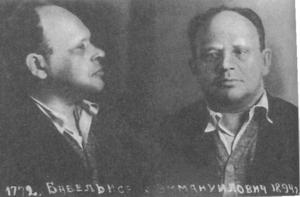
This afternoon, I stopped by the St. Mark’s Bookshop to look through the Collected Stories of Isaac Babel on my way to buy groceries for dinner. I found the book in the back of the bookstore, on a shelf below Paul Auster and above Italo Calvino. I knelt down and read about how Babel had been killed by the NKVD, after he was arrested, forced to confess, and shuttled to a prison camp in Siberia.
To my left, beyond the table of discounted books, an agitated man with white-hair and a short, neat beard was talking politics with the woman behind the desk. When he mentioned Rumsfeld, he swung his arm above his head to make a point. When I looked over to him I noticed that I was crouching next to a rack of postcards with photos of the president and his administration. Their faces had been doctored, certain features were elongated, others erased. Rumsfeld was a monster with tiny eyes and a sharp pointed head.
“The people I know who have been shot,” man with the white hair declared, “were shot because they were thoroughly understood.”
“That’s what I’m saying,” said the woman. “It’s better to be misunderstood.”
“I totally disagree,” he said. “I want them to understand me. That’s what’s important.”
“But then they’ll shoot you.”
“Great.” He threw both hands above his head.
“But you’ll die.”
“At least then they’ll understand who they were messing with.”
Thursday, May 25, 2006
The Slush Pile and the World
I recommend Sven Birkerts's introductory essay, "Finding Traction," in the new issue of AGNI, issue #63. He starts with the daily tackling of submissions to the magazine:
When I sit down with a huge stack of envelopes, each one containing some hard-won, deliberated expression, I am not the tabula rasa—the fantasied clean slate—that I perhaps ought to be. No, I am a man of my time, a besieged reader, creating a specific occasion within what is, day in and day out, for me as for most everyone, a near-constant agitation of stimuli, an enfolding environment of aggressively competing signs and meanings. And my attitude, when I remove a clump of print-covered pages from their envelope, is not "Send me more and more new information" but "Reach me, convince me that this news is different, that this is the news I need."And he somehow works his way from there, from the speed with which he's able to make his way through the slush pile each morning, to a consideration of the enormous changes that have taken place in the culture in the past ten years, in which, if I understand him correctly, we have all become robots. Or maybe it's that we're all still human, but our flesh and blood has been mold-injected into the invisible husks of robots. No wait, it's like we all now have little tiny microscopic robots that squat in our frontal lobes, dug in like a first assault, like a world-wide brain tissue Oklahoma land rush. Or maybe it's just that AGNI refuses to publish stories and poems written by robots, even though robots pretending to be humans are submitting to the journal all the time, but they give themselves away, because robots always use Tyvek envelopes, and their manuscripts are covered in little metal shavings, the residue of their tears.
Saturday, May 20, 2006
The Paper Cut
After alcoholism, heart-disease, near-sightedness, divorce, bankruptcy, and depression, the paper cut is the most serious occupational hazard of the writer. Its menace passes largely unnoticed, and we are all its silent victims.
All paper cuts are not created equal, but each is nasty in its own way. The truly painful paper cut seems to hurt more than it has any right to. We understand the justice of bruises, burns, and scrapes - the pain we feel seems proportional to the evidence of the injury, but the case of the paper cut confounds us. A little epidermal slice, a spot of blood, are all we have to show for our affliction. Any calls for sympathy are in vain. The paper cut infantilizes the writer. We suck our fingers in disgrace.
Moreover, the paper cut is the painful reminder of the physical nature of the book. As much as we may wish to believe that in the beginning was the Word, we know that things were here first, and that they will remain long after the last remnants of language have disintegrated.
All paper cuts are not created equal, but each is nasty in its own way. The truly painful paper cut seems to hurt more than it has any right to. We understand the justice of bruises, burns, and scrapes - the pain we feel seems proportional to the evidence of the injury, but the case of the paper cut confounds us. A little epidermal slice, a spot of blood, are all we have to show for our affliction. Any calls for sympathy are in vain. The paper cut infantilizes the writer. We suck our fingers in disgrace.
Moreover, the paper cut is the painful reminder of the physical nature of the book. As much as we may wish to believe that in the beginning was the Word, we know that things were here first, and that they will remain long after the last remnants of language have disintegrated.
Monday, May 15, 2006
Kafka Was the Rage
"The competition was friendly, laced with admiration and respect, but it was as fierce as only a match between close friends can be, and it brought out the best in them [...] It was, in fact, competition as much as collaboration that linked Ashbery and O'Hara and Schuyler and Koch so tightly that they acquired a group identity with a collective force. 'Collaboration, a direct extension of O'Hara's mode of living, is a good metaphor for the manner of his relationships--an intimate competition in which each participant goads the other toward being at his best,' the poet and art critic Peter Schjeldahl perceptively noted. Or as Koch advised the young poets who came to him for instruction at Columbia, 'Have some friends who are so good it scares you.'"
--from David Lehman's The Last Avant-Garde: The Making of the New York School of Poets, p. 71 (in chapter two, "Band of Rivals")
Note also, in the author interviews on the One Story site, Andrew Foster Altschul's answer to the question on writing advice and the importance of having friends who are also writers, as well as Kelly Link's answer to the same question, about the importance of having friends who are not writers (or rather, friends whose lives are melodramatic; I'm jumping to the conclusion that writing and melodrama are mutually exclusive, which was certainly not the case with the New York School).
--from David Lehman's The Last Avant-Garde: The Making of the New York School of Poets, p. 71 (in chapter two, "Band of Rivals")
Note also, in the author interviews on the One Story site, Andrew Foster Altschul's answer to the question on writing advice and the importance of having friends who are also writers, as well as Kelly Link's answer to the same question, about the importance of having friends who are not writers (or rather, friends whose lives are melodramatic; I'm jumping to the conclusion that writing and melodrama are mutually exclusive, which was certainly not the case with the New York School).
He Also Did The Crossword (in Pen)
The latest piece of evidence submitted in the case against I. Lewis Libby Jr. includes articles from the Times, the Post, and the Chicago Sun Times, as well as an image scanned from Cheney's copy of the Joseph Wilson Op-Ed piece, "What I didn't find in Africa." Written above the title are a few jotted down notes in what Fitzgerald believes is the VP's neat, confident handwriting, including the question: "Did his wife send him on a junket?" The image was printed in Sunday's Times, and is available online (together with the rest of the evidence) as a pdf.
Friday, May 12, 2006
Interview: A Retrospective
In light of my recent EWP interview, I've been reflecting on past job interviews. Here are some of the highlights:
Smith-Craine Finance, San Francisco, 1999: Receptionist
Ed Craine: The job requires a lot of Xeroxing. How do you feel about that?
J: I feel good about it. (pause). Great. (pause). I actually find the sound of the Xerox relaxing. The smell of toner is not at all offensive to me.
Interaction Associates, San Francisco, 1996: Assistant to Office Manager
Inspired Office Manager: Interaction Associates wants to inspire. Our job is to inspire. Your job is to keep the candy tray full.
J: Yes, I see.
Inspired Office Manager: Any questions?
J: Do I need to fill the candy in an inspiring way?
Alta Vista Car Wash, San Diego, 1994: Guy who stands in the middle of the car wash while wearing a rain slicker and scrubbing the cars
Racist Jock: I usually hire Mexicans. They're good workers.
J: I'm a good worker.
Racist Jock: But you're not a Mexican.
J: I used to work at Taco Time.
Taco Time, San Diego, 1994: Cook
Girl with a face like a day-old enchilada: You have to wear this stupid visor.
J: That's okay. I like it.
Girl with a face like a day-old enchilada: And this stupid t-shirt.
J: Lovely.
Girl with a face like a day-old enchilada: Do you have a girlfriend?
J: I just want to make tacos.
Edwards Cinema, San Diego, 1994: Guy who rips tickets
Sad 46-year old: You get free movies.
J: Great.
Sad 46-year old: Yeah, and free popcorn.
J: Even better.
Sad 46-year old: It's really not so bad. I've seen True Lies 23 times. Do you maybe want to see it later?
J: Is this an interview?
(I was later fired from my position and replaced by a retarded person).
Smith-Craine Finance, San Francisco, 1999: Receptionist
Ed Craine: The job requires a lot of Xeroxing. How do you feel about that?
J: I feel good about it. (pause). Great. (pause). I actually find the sound of the Xerox relaxing. The smell of toner is not at all offensive to me.
Interaction Associates, San Francisco, 1996: Assistant to Office Manager
Inspired Office Manager: Interaction Associates wants to inspire. Our job is to inspire. Your job is to keep the candy tray full.
J: Yes, I see.
Inspired Office Manager: Any questions?
J: Do I need to fill the candy in an inspiring way?
Alta Vista Car Wash, San Diego, 1994: Guy who stands in the middle of the car wash while wearing a rain slicker and scrubbing the cars
Racist Jock: I usually hire Mexicans. They're good workers.
J: I'm a good worker.
Racist Jock: But you're not a Mexican.
J: I used to work at Taco Time.
Taco Time, San Diego, 1994: Cook
Girl with a face like a day-old enchilada: You have to wear this stupid visor.
J: That's okay. I like it.
Girl with a face like a day-old enchilada: And this stupid t-shirt.
J: Lovely.
Girl with a face like a day-old enchilada: Do you have a girlfriend?
J: I just want to make tacos.
Edwards Cinema, San Diego, 1994: Guy who rips tickets
Sad 46-year old: You get free movies.
J: Great.
Sad 46-year old: Yeah, and free popcorn.
J: Even better.
Sad 46-year old: It's really not so bad. I've seen True Lies 23 times. Do you maybe want to see it later?
J: Is this an interview?
(I was later fired from my position and replaced by a retarded person).
Thursday, May 11, 2006
The Great American Novel *
* - As determined by a plurality of votes from the hundred or so judges chosen by the NYTBR, a number of whom (according to A.O. Scott) "declined to answer, some silently, others with testy eloquence."
From the Times website:
"Early this year, the Book Review's editor, Sam Tanenhaus, sent out a short letter to a couple of hundred prominent writers, critics, editors and other literary sages, asking them to please identify 'the single best work of American fiction published in the last 25 years.'"
Their list of "literary sages" includes everyone from Harold Bloom to Aimee Bender.
The results are posted here.
A.O. Scott's effort to make sense of the results is worth reading.
From the Times website:
"Early this year, the Book Review's editor, Sam Tanenhaus, sent out a short letter to a couple of hundred prominent writers, critics, editors and other literary sages, asking them to please identify 'the single best work of American fiction published in the last 25 years.'"
Their list of "literary sages" includes everyone from Harold Bloom to Aimee Bender.
The results are posted here.
A.O. Scott's effort to make sense of the results is worth reading.
Wednesday, May 10, 2006
An Oral History of Our Time
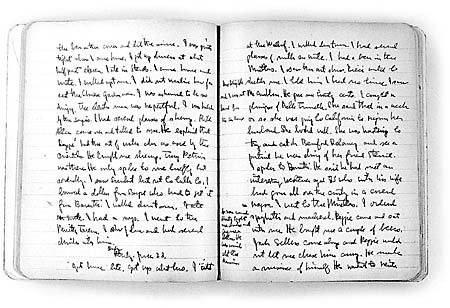
Thanks to Joseph Mitchell's book everybody knows Joe Gould's secret. The great project he told everyone he was working on, the oral history of our time that would encompass the chitchat at artists parties in the Village, the political speeches at rallies at Union Square and the talk in the hallways of flophouses on Bowery, that grand work that would make him the equal of Gibbon, was never realized. The dime-store composition books he left behind contain only a spotty diary account of his own habits:
June 7, 1946: I saw Bele De Triefant. He said he had a pair of shoes for me. I had an ale at the Minetta.
June 8: De Triefant had not brought the shoes. I had a drink at the Minetta.
June 11: I saw De Triefant. He had shoes for me. I took them. I went to the Minetta. I drank.
June 12: I went to Goody's. I had some beers. I lost my shoe. I went to the Minetta.
(from Charles Hutchinson & Peter Miller's article in the Voice)
The books are now housed on the 3rd Floor of Bobst.
There a few brave souls today who seem to have taken up his project. Like Gould, they believe that "what people say is history." One of these brave souls, of course, is the guy behind OverheardinNewYork. Another is whoever put up this story from a rapper named Saigon:
"I was at 23rd and 9th Street, that’s where everybody goes after the club," Saigon told HipHopGame.com. "I’m out there with me and my man. My man is 135 lbs. soaking wet. I have an $18,000 chain on. I guess someone thought I was food. They were probably scheming the whole time. I didn’t even realize it. One of them asked my man if he sold weed. My man was like, “Nah.” We were with these girls. One of the kids walked up to me. I thought he was a fan. He snatched the chain right off my neck. I took it right back from him and my man knocked him out. My man dropped him. We’re stomping this nigga out thinking he’s crazy that he’s going to come and snatch my chain.
We didn’t know he was with somebody else. His homeboy came behind me and stabbed me in my temple. I lost a lot of blood. When he stabbed me, I started fighting the nigga but I was losing a lot of blood. I faked a jack like I had a ratchet on me. I didn’t have no burner. I was like, “Hit the nigga, hit the nigga.” They started running. Me and my nigga were standing there and they ran.I had my chain and both of their cell phones. They dropped their cell phones when they started running. I’m out there like, “Yeah nigga!” but at the same time I’m losing a lot of blood..." [More]
Subscribe to:
Comments (Atom)