Wednesday, May 31, 2006

Babel in the East Village


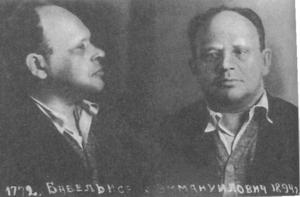
This afternoon, I stopped by the St. Mark’s Bookshop to look through the Collected Stories of Isaac Babel on my way to buy groceries for dinner. I found the book in the back of the bookstore, on a shelf below Paul Auster and above Italo Calvino. I knelt down and read about how Babel had been killed by the NKVD, after he was arrested, forced to confess, and shuttled to a prison camp in Siberia.

To my left, beyond the table of discounted books, an agitated man with white-hair and a short, neat beard was talking politics with the woman behind the desk. When he mentioned Rumsfeld, he swung his arm above his head to make a point. When I looked over to him I noticed that I was crouching next to a rack of postcards with photos of the president and his administration. Their faces had been doctored, certain features were elongated, others erased. Rumsfeld was a monster with tiny eyes and a sharp pointed head.

“The people I know who have been shot,” man with the white hair declared, “were shot because they were thoroughly understood.”

“That’s what I’m saying,” said the woman. “It’s better to be misunderstood.”

“I totally disagree,” he said. “I want them to understand me. That’s what’s important.”

“But then they’ll shoot you.”

“Great.” He threw both hands above his head.

“But you’ll die.”

“At least then they’ll understand who they were messing with.”

Thursday, May 25, 2006

The Slush Pile and the World

I recommend Sven Birkerts's introductory essay, "Finding Traction," in the new issue of AGNI, issue #63. He starts with the daily tackling of submissions to the magazine:
When I sit down with a huge stack of envelopes, each one containing some hard-won, deliberated expression, I am not the tabula rasa—the fantasied clean slate—that I perhaps ought to be. No, I am a man of my time, a besieged reader, creating a specific occasion within what is, day in and day out, for me as for most everyone, a near-constant agitation of stimuli, an enfolding environment of aggressively competing signs and meanings. And my attitude, when I remove a clump of print-covered pages from their envelope, is not "Send me more and more new information" but "Reach me, convince me that this news is different, that this is the news I need."
And he somehow works his way from there, from the speed with which he's able to make his way through the slush pile each morning, to a consideration of the enormous changes that have taken place in the culture in the past ten years, in which, if I understand him correctly, we have all become robots. Or maybe it's that we're all still human, but our flesh and blood has been mold-injected into the invisible husks of robots. No wait, it's like we all now have little tiny microscopic robots that squat in our frontal lobes, dug in like a first assault, like a world-wide brain tissue Oklahoma land rush. Or maybe it's just that AGNI refuses to publish stories and poems written by robots, even though robots pretending to be humans are submitting to the journal all the time, but they give themselves away, because robots always use Tyvek envelopes, and their manuscripts are covered in little metal shavings, the residue of their tears.

Saturday, May 20, 2006

The Paper Cut

After alcoholism, heart-disease, near-sightedness, divorce, bankruptcy, and depression, the paper cut is the most serious occupational hazard of the writer. Its menace passes largely unnoticed, and we are all its silent victims.

All paper cuts are not created equal, but each is nasty in its own way. The truly painful paper cut seems to hurt more than it has any right to. We understand the justice of bruises, burns, and scrapes - the pain we feel seems proportional to the evidence of the injury, but the case of the paper cut confounds us. A little epidermal slice, a spot of blood, are all we have to show for our affliction. Any calls for sympathy are in vain. The paper cut infantilizes the writer. We suck our fingers in disgrace.

Moreover, the paper cut is the painful reminder of the physical nature of the book. As much as we may wish to believe that in the beginning was the Word, we know that things were here first, and that they will remain long after the last remnants of language have disintegrated.

Monday, May 15, 2006

Kafka Was the Rage

"The competition was friendly, laced with admiration and respect, but it was as fierce as only a match between close friends can be, and it brought out the best in them [...] It was, in fact, competition as much as collaboration that linked Ashbery and O'Hara and Schuyler and Koch so tightly that they acquired a group identity with a collective force. 'Collaboration, a direct extension of O'Hara's mode of living, is a good metaphor for the manner of his relationships--an intimate competition in which each participant goads the other toward being at his best,' the poet and art critic Peter Schjeldahl perceptively noted. Or as Koch advised the young poets who came to him for instruction at Columbia, 'Have some friends who are so good it scares you.'"

--from David Lehman's The Last Avant-Garde: The Making of the New York School of Poets, p. 71 (in chapter two, "Band of Rivals")

Note also, in the author interviews on the One Story site, Andrew Foster Altschul's answer to the question on writing advice and the importance of having friends who are also writers, as well as Kelly Link's answer to the same question, about the importance of having friends who are not writers (or rather, friends whose lives are melodramatic; I'm jumping to the conclusion that writing and melodrama are mutually exclusive, which was certainly not the case with the New York School).

He Also Did The Crossword (in Pen)

The latest piece of evidence submitted in the case against I. Lewis Libby Jr. includes articles from the Times, the Post, and the Chicago Sun Times, as well as an image scanned from Cheney's copy of the Joseph Wilson Op-Ed piece, "What I didn't find in Africa." Written above the title are a few jotted down notes in what Fitzgerald believes is the VP's neat, confident handwriting, including the question: "Did his wife send him on a junket?" The image was printed in Sunday's Times, and is available online (together with the rest of the evidence) as a pdf.

Friday, May 12, 2006

Interview: A Retrospective

In light of my recent EWP interview, I've been reflecting on past job interviews. Here are some of the highlights:

Smith-Craine Finance, San Francisco, 1999: Receptionist

Ed Craine: The job requires a lot of Xeroxing. How do you feel about that?

J: I feel good about it. (pause). Great. (pause). I actually find the sound of the Xerox relaxing. The smell of toner is not at all offensive to me.

Interaction Associates, San Francisco, 1996: Assistant to Office Manager

Inspired Office Manager: Interaction Associates wants to inspire. Our job is to inspire. Your job is to keep the candy tray full.

J: Yes, I see.

Inspired Office Manager: Any questions?

J: Do I need to fill the candy in an inspiring way?

Alta Vista Car Wash, San Diego, 1994: Guy who stands in the middle of the car wash while wearing a rain slicker and scrubbing the cars

Racist Jock: I usually hire Mexicans. They're good workers.

J: I'm a good worker.

Racist Jock: But you're not a Mexican.

J: I used to work at Taco Time.

Taco Time, San Diego, 1994: Cook

Girl with a face like a day-old enchilada: You have to wear this stupid visor.

J: That's okay. I like it.

Girl with a face like a day-old enchilada: And this stupid t-shirt.

J: Lovely.

Girl with a face like a day-old enchilada: Do you have a girlfriend?

J: I just want to make tacos.

Edwards Cinema, San Diego, 1994: Guy who rips tickets

Sad 46-year old: You get free movies.

J: Great.

Sad 46-year old: Yeah, and free popcorn.

J: Even better.

Sad 46-year old: It's really not so bad. I've seen True Lies 23 times. Do you maybe want to see it later?

J: Is this an interview?

(I was later fired from my position and replaced by a retarded person).

Thursday, May 11, 2006

The Great American Novel *

* - As determined by a plurality of votes from the hundred or so judges chosen by the NYTBR, a number of whom (according to A.O. Scott) "declined to answer, some silently, others with testy eloquence."

From the Times website:
"Early this year, the Book Review's editor, Sam Tanenhaus, sent out a short letter to a couple of hundred prominent writers, critics, editors and other literary sages, asking them to please identify 'the single best work of American fiction published in the last 25 years.'"

Their list of "literary sages" includes everyone from Harold Bloom to Aimee Bender.

The results are posted here.

A.O. Scott's effort to make sense of the results is worth reading.

Wednesday, May 10, 2006

An Oral History of Our Time


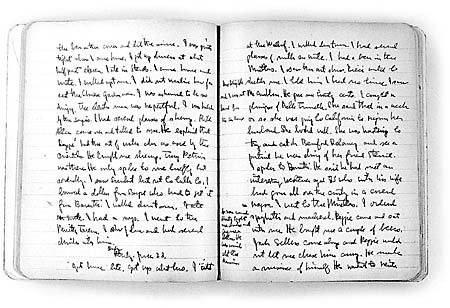
Thanks to Joseph Mitchell's book everybody knows Joe Gould's secret. The great project he told everyone he was working on, the oral history of our time that would encompass the chitchat at artists parties in the Village, the political speeches at rallies at Union Square and the talk in the hallways of flophouses on Bowery, that grand work that would make him the equal of Gibbon, was never realized. The dime-store composition books he left behind contain only a spotty diary account of his own habits:

June 7, 1946: I saw Bele De Triefant. He said he had a pair of shoes for me. I had an ale at the Minetta.
June 8: De Triefant had not brought the shoes. I had a drink at the Minetta.
June 11: I saw De Triefant. He had shoes for me. I took them. I went to the Minetta. I drank.
June 12: I went to Goody's. I had some beers. I lost my shoe. I went to the Minetta.
(from Charles Hutchinson & Peter Miller's article in the Voice)

The books are now housed on the 3rd Floor of Bobst.

There a few brave souls today who seem to have taken up his project. Like Gould, they believe that "what people say is history." One of these brave souls, of course, is the guy behind OverheardinNewYork. Another is whoever put up this story from a rapper named Saigon:

"I was at 23rd and 9th Street, that’s where everybody goes after the club," Saigon told HipHopGame.com. "I’m out there with me and my man. My man is 135 lbs. soaking wet. I have an $18,000 chain on. I guess someone thought I was food. They were probably scheming the whole time. I didn’t even realize it. One of them asked my man if he sold weed. My man was like, “Nah.” We were with these girls. One of the kids walked up to me. I thought he was a fan. He snatched the chain right off my neck. I took it right back from him and my man knocked him out. My man dropped him. We’re stomping this nigga out thinking he’s crazy that he’s going to come and snatch my chain.

We didn’t know he was with somebody else. His homeboy came behind me and stabbed me in my temple. I lost a lot of blood. When he stabbed me, I started fighting the nigga but I was losing a lot of blood. I faked a jack like I had a ratchet on me. I didn’t have no burner. I was like, “Hit the nigga, hit the nigga.” They started running. Me and my nigga were standing there and they ran.I had my chain and both of their cell phones. They dropped their cell phones when they started running. I’m out there like, “Yeah nigga!” but at the same time I’m losing a lot of blood..." [More]

Tuesday, May 09, 2006

Saturday Night Minutiae

When I finished reading the last sentence of my story, I took my two pages, which I'd folded over two or three times to fit in my back pocket, and I smacked the lectern with the vertical crease, as if to indicate "the end," or "I am done reading now." I smacked on impulse, not thinking about it. It felt appropriate, although the gesture might have been so small as to not even be noticeable to the audience. I don't know.

Immediately after, as I squatted next to the bar, my hands still shaking, I thought about Will Ferrell's line from Old School: "That's the way you do it! That's the way you debate!" Maybe some variant on that, I thought, would be the best way to end a reading.

It could certainly be beneficial to writers facing the conundrum of having brought their serious material to a almost entirely humorous event.

Or it could turn the whole proceedings into something not unlike kabuki?

Which, in the world of readings, would not necessarily be a bad thing.

Wednesday, May 03, 2006

Reading Report

The old man got up to the podium. He said a few words before he read his two poems by the dead poet, the poet whose memory this reading was honoring. He said the dead poet would have been great without the disease. The disease that was the poet's subject, a subject that spanned three books. He said he'd made this comment before to the poet's companion, who was there, sitting in the front row. But where did this comment's emphasis lie? I wanted to give this old man the benefit of the doubt, I wanted to believe he meant the emphasis to land on the "without" (I'm paraphrasing here, I think he might have actually said "hadn't had"), meaning that the greatness existed regardless of the subject matter, rather than what it sounded like he was saying, what I feared he was saying, which was that the poet's work had been hamstrung by the singularity of the subject. When he sat down, the air of the room shook with the sound of the old man's sheaf of poems, which he struggled to cram back into his inside suit coat pocket, his hand shaking uncontrollably, a Parkinson's tremor, his face locked in the expression of an old man's revulsion at his own crippled body.

Sunday, April 30, 2006

Right of First Refusal + Rejection Note = Refusal Note

(an attempted reconstruction of a collective effort)

Dear Sir/Madam:

A pox upon you for submitting your work to our journal. We receive a large number of submissions every month, and none of them compare to the contemptibleness of yours. We have read your pages with disgust and horror. No, no, a thousand times no, we shall not consider publishing such garbage. Our current need is that we might forget the stain your words have left on our retinas. If we could cause this self-addressed, stamped envelope--the one enclosure with any sense in your most objectionable mailing--to projectile vomit onto your shirtfront right now, believe us, we would indeed. We do not merely pass on your work; rather, we kick you, and your work, dead on in the nut sack with our steel-toed editorial boots. Your pages are not fit to wipe with, and yet we have, because we felt we must, and thus our bottoms are riddled with inky little paper cuts, but we are glad of this, because it is nothing compared to the torn and bleeding flesh you have wrought upon our minds. We do not wish you luck placing your work elsewhere; rather, we earnestly pray that you never write another word again, burn every page that has regretfully dropped from your wretched bunghole to date, and do penance for the harm you have caused us, and literature, preferably involving violently painful flagellation, from this day to the one on which your corpse is blessedly lowered into the ground.

Regards,
The Editors

Eleventh Street in the Times

Eleventh Street is all over today's Times, from Jane Jacobs's barstool at the Whitehorse, where she argued that the city of the future should look a lot like the West Village of the 60s (as opposed to the West Village of the present where, according to the paper of record, the red benches of the White Horse are filled by "graduate students from nearby New York University and would-be writers"), to the 11th Street Bar, where Chuck Klosterman mulls over his latest humiliation.

Sunday, April 23, 2006

The Strange Story of Our Earth

The library here, in this creaky old hunter's cabin by the side of the road, is a weird mix of books about machines, nature, and Christianity--with titles such as Bear!, Fix Your Chevrolet, Cowpokes Ride Again, Old Gun Catalogs, Best Ways to Catch More Fish in Fresh and Salt Water, Is the Bible REALLY the Word of God?, and Father Smith Instructs Jackson, a instructional manual for Catholicism written entirely in Socratic dialogue form.

But my favorite so far is The Strange Story of Our Earth, a science book for kids, published in 1952. It reads like science written by Nabokov's Kinbote; in other words, you might hope that a book about something "strange" would answer questions, but instead it leaves them dangling and convoluted, the author preferring to pick fights with unnamed enemies. I can't imagine a kid reading this and not wanting to run the hell away from science, screaming.

This is the book's final paragraph:

If the ancient inhabitants of America domesticated the Megatherium why shouldn't they have domesticated other creatures including the horses? At all events even if some scientists will not admit that the first Americans originated in America they must admit that the Americans were the first men to domesticate large animals, for as far as known, dogs were the only animals domesticated by the men of the Old World at the time.


Why should they not have indeed? replies the 10-year-old in the early fifties, making a mental note to give the humanities a closer look.

Saturday, April 22, 2006

Gross Anatomy: The View from the 9th Floor of the Library


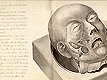
The view from the 9th floor of the library extends downtown over the rooftops of Soho all the way to Wall Street. If you stare hard to the Southwest you can make out the blue hills of New Jersey. I often bring my work to the 9th floor, which houses the university science library, and sit by the window. The view offers just the right amount of distraction for me to work. One gray day like today when the city seemed particularly ugly (and New Jersey had disappeared into the mist), I distracted myself reading the mysterious titles of medical books on the shelf in front of me. Wound Care and The Acute Hand sounded like titles of poetry chapbooks. An Atlas of Vulval DiseasesIowa Head and Neck Protocols… The ambiguous Principles and Practice of Nurse Anesthesia… I put away my work and took Obstetric and Gynecological Milestones ILLUSTRATED off the shelf. Chapter 26 was titled “Thomas Wharton and the Jelly of the Umbilical Chord.” Another chapter was a reproduction of William Hunter’s illustrated Anatomia Uteri Humani Gravidi from 1751, a work of art whose terrifying images of dissection show the body to be both beautiful and monstrous. They make Damien Hirst's Virgin Mother look like a third grade diorama.

Links to Historical Anatomies on the website of the National Institutes of Health.

Thursday, April 20, 2006

James Wood on Flaubert

There is a good James Wood and a bad James Wood. The good one sings when he writes about Bellow, the bad one just sulks eloquently. The bad James Wood published a poisonous condemnation of the "New York" novel and its practitioners McInerney, Ellis, and recently Rushdie, in The Guardian on Oct 6, 2001. The headline was "How does it feel?" The good James Wood has just given us a thorough and insightful essay on Flaubert's legacy in the guise of a review of the "magnificent" new biography of the writer.

Wood offers a fine reading of Flaubert's "superb and magnificently isolate" details in this passage from The Sentimental Education:
At the back of deserted cafes, women behind the bars yawned between their untouched bottles; the newspapers lay unopened on the reading-room tables; in the laundresses' workshops the washing quivered in the warm draughts. Every now and then he stopped at a bookseller's stall; an omnibus, coming down the street and grazing the pavement, made him turn round; and when he reached the Luxembourg he retraced his steps.

Flaubert, he argues, "is the greatest exponent of a technique that is essential to realist narrative: the confusing of the habitual with the dynamic... [his] details belong to different time-signatures, some instantaneous and some recurrent, yet they are smoothed together as if they are all happening simultaneously."

Saturday, April 15, 2006

Tonight's Featured Act

She was talking about going to hear Dawn Raffel read, but the words formed in my head as Don Raffle. Maybe the former is pronounced the same as the latter? Neither of us were sure. I started imagining what a writer like Don Raffle would be like. A Borscht Belt comedian of a writer. The Fozzie Bear of fiction. "How's everybody doing tonight?" he hollers, stumbling out on stage in his tawdry suit and hat. He's got a martini in one hand, microphone in the other, pages up his sleeve. Is his voice Fozzie's, or Krusty the Clown's? There's feedback from the PA. "Are you ready for some short stories?" The last word drawn out like taffy. Oh yes. It's late, the audience is drunk, it's a long drive home, the audience wants to be entertained. Maybe literary fiction should be more like bawdy jokes about farmers' daughters and popes walking into bars, priests and hookers and presidents on lifeboats. I think I want to be Don Raffle.

Thursday, April 13, 2006

More on the Q&A

What I remember: The conundrum of the bumblebee. Cueing fetishes, talismanic pages. Not knowing how to solve the problem of the project until you're inside it. Ideas agglomerate. Roth: job is to make a book smarter than its author. Maugham, Mann: Waiting to write the bildungsroman. "I'm a great believer in bohemian life." The value of the intimate and useless. Trillin on Babel via Wachtel: The human fact within the vale of circumstance. I heard the lyric as "monster eyes." I was so happy the kangaroo was named Shelf.

Monday, April 10, 2006

EL Doctorow on the Research in the Novel (An interview by Ron Carlson)

(This interview with the writer Ron Carlson was done for the show Books & Co on KAET TV in Arizona. I'm posting it here because it seems to have been dropped from its home web server. I found it in Google's cache.)

Ron Carlson: What obligation do you have to your research? Because you've done a lot of research. You've written a lot about different places.

E.L. Doctorow: I don't know if what I do can be called research. It's so idiosyncratic and subjective. I've known too many writers who have researched things so thoroughly that they're stopped in their tracks.

Ron Carlson: That's what I'm asking.

E.L. Doctorow: And I believe when I'm asked this question "How much have you researched," I say, "Just enough." You start writing, and if you are writing well, I think really you create kind of a magnet force field around you. Whatever you need will come to hand. You'll see something in the street or run into -- I'll give you an example. In "Ragtime," I wrote a scene in which this -- the old silhouette artist Tateh and his little girl take streetcars from New York up to Lowell, Massachusetts, on the interurban street lines, which I knew were very widespread in those days, in the 1910s era, but I felt, well, this is really a stretch, and I’d better find out if it was possible to do this. But I didn't know how to go about researching it. So I was wandering around in the New York Public Library in the mid-Manhattan branch through the stacks, and my knee banged into a shelf of oversized books that were protruding from the shelf, and there was one with a big orange cover that was very prominent. So I just picked it up and looked at it, and it was a history of trolley car companies in America. And I’d found out, yes, you could go to Lowell, Massachusetts, from New York paying nickels with each new line. In fact, you could go from New York to Chicago by streetcar in those days, and it was a great system, and it was destroyed probably -- J.P. Morgan bought up some lines that he felt were competing with the new haven railroad. He destroyed them. Then the general motors corporation went around to cities saying buses are much cleaner and better, which was not true. And so trolley cars, streetcar transportation folded. Too bad.

Ron Carlson: But you found that book by accident.

E.L. Doctorow:By accident.

Ron Carlson: So it's a little different now with the internet. Everyone researches everything on the internet. It's all I hear about. People are "Googling" and finding out this stuff. You don't have a research staff? You just do your own research, correct?

E.L. Doctorow: I don't use a research -- one book I hired a guy to get some old magazines for me. I guess that was for "World's Fair." but, you know, a lot of what you make up is simply applying yourself logically to the situation, and there's really not that much trouble. I never corrected the problem in "Welcome To Hard Times." I left it. You know the Hawthorne story, the birthmark, where this man's married to this beautiful woman and she's absolutely perfect, and he loves her, but she has a little birth mark on her cheek in the shape of a tiny hand, and he's a natural scientist, so he concocts a potion and says, "Drink this and the birthmark will disappear and you'll be perfect." Because she loves him, she drinks it and the birthmark disappears and at that moment she dies. So that's why I've left Jenks out eating the roast haunch of prairie dogs.

Ron Carlson: Leave your beautiful flaws.

E.L. Doctorow: You want flaws.

Ron Carlson:Sure, I understand. Talking about research, so many times the question becomes your responsibility to be exact but, I mean, what you're saying is very much more kindred to what I've experienced, that is to say, as you focus on the work, that what you're writing becomes its own research, that you create and find the information you need.

E.L. Doctorow: I think so. You do look things up, but basically you have to trust the act of writing to guide you.
Notes from the Reading by Darin Strauss and Jonathan Lethem:

Washington Square, March 30, 2006.

During the Q+A, Darin Strauss confessed he watched The Godfather 2 twenty times over the course of writing his first novel, Chang and Eng, to study the double-narrative structure. People these days, he argued, are paranoid about plagiarism. A writer should read widely taking what he can. On the other hand, one should be cautious about research. Strauss said that it was only when he was writing his first novel that he discovered the real truth behind the funny response Doctorow once gave to the question: how much research do you do for a novel? - As little as possible, he said.

Jonathan Lethem warned aspiring novelists that “an idea for a novel is not enough for a novel.” He said that his general reaction to reading “apprentice fiction” is “Do more. Do this and something else or 10 other things, but not just this one thing. Do more.”
After the Q+A, Strauss read briskly from his novel-in-progress about an adman in Long Island. As listeners, we sometimes felt forced to run to catch up to him, chasing one biting description after another. In the office scenes, the description was often aphoristic (“Small talk abhors a vacuum;” “The dotcom bubble’s contribution to the world of business was a residue of counterfeit wackiness.”) His metaphors and similes created a strange beauty from the dreary world of office supplies: “The overhead light jiggled. Everyone held still as if they were being photocopied.”

Lethem read from the beginning of a new novel about the breakup of a couple who are in the same band together. He’s the guitarist. She’s the bassist. Both of them have day jobs that take up most of their time. He works at the zoo, cleaning up after kangaroos. Though Lethem read with flair, the first section felt a bit flip – a satire with an easy target: sorta-hipsters stewing in their unrealized ambitions. The audience laughed along in sympathy. Especially the poets. In the scene, the band writes a song together, improvising the lyrics. Lethem sang the refrain, “Keep away from my monster gaze!” It was a real performance. He sounded a little like David Berman from the Silver Jews. The lyrics needed to be improvised because the band’s songwriter was “having a problem with language.”

“What do you mean?” the guitarist asks.

“You know, the place where it comes from.”

The MFA poets in the room laughed until tears came to their eyes.

The later scenes from the book involved an awkward conversation at the grocery store and a kidnapped kangaroo in a bathtub.

A brief reception followed. Refreshments were served.

One-Word Poem

Big Al: So, Eric, you teach writing. I’m a terrible writer. The worst. When I was in grade school, our teacher told me we had to write a one-word poem.
Mike: What the hell’s a one-word poem?
Big Al: Exactly. It’s stupid. I said I’m not gonna do this shit. So she calls up my mother and says your kid’s an asshole he won’t write his poem. My mom says, if he don’t wanna do it, don’t make him do it.
Mike: How about “Fuck”? That’s a good one-word poem.
Big Al: Nah, she said it was like “Love.”
Me: That sounds like an awful poem.
Mike: Yeah, “Fuck” is way better.